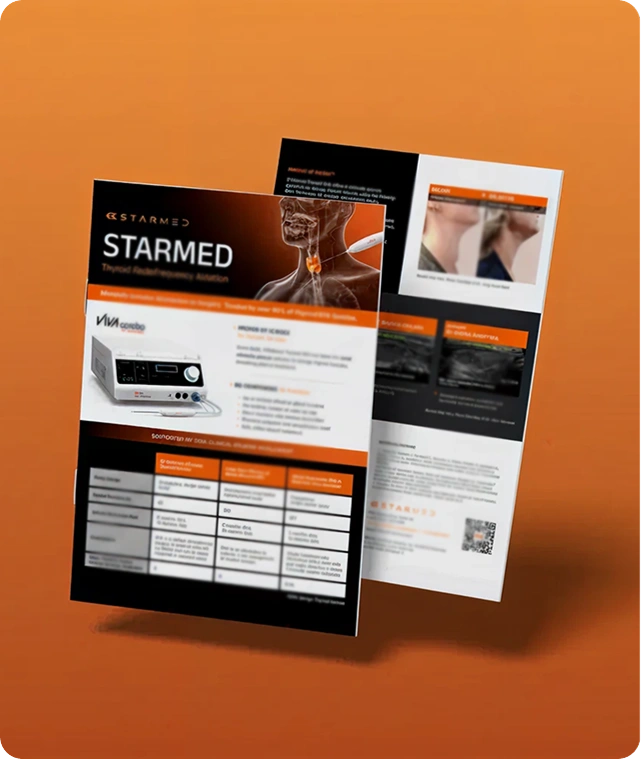
TL;DR: This guide compares two minimally invasive options for thyroid nodule management, radiofrequency ablation (RFA) and Nanopulse (nsPFA), highlighting how each approach works, where it fits clinically, and what providers should consider when selecting a treatment strategy.
- RFA is a mature, evidence-backed modality that uses thermal energy to achieve 50–80% thyroid nodule volume reduction within 6–12 months while preserving thyroid function and supporting broad international guideline recommendations.
- Nanopulse is an emerging, nonthermal technology that induces cell death through irreversible electroporation, offering potential advantages for nodules near critical structures, though long-term data remain limited.
- Both treatments are outpatient procedures performed under local anesthesia, with rapid recovery and minimal disruption to daily activities.
- Safety profiles differ primarily by mechanism, with RFA supported by extensive long-term outcomes data and Nanopulse showing promising early safety results.
- Practice considerations favor RFA today, given established CPT Category I codes and increasing insurance coverage, while Nanopulse reimbursement pathways continue to evolve.
Advances in minimally invasive technologies have expanded the available options for thyroid nodule management. Today, clinicians can treat patients with select thyroid nodules without the need for open surgery or lifelong medications. Two such approaches include radiofrequency ablation (RFA) and Nanopulse, also known as nanosecond pulsed field ablation (nsPFA).
Both modalities are image-guided, percutaneous treatments, but their basic mechanisms and ideal use cases vary. In this guide, we’ll explain both RFA and nanopulse so that you can ensure you’re offering the most appropriate treatment to your patients.
About Radiofrequency Ablation (RFA) for Thyroid Nodule Management
RFA uses high-frequency alternating current to generate localized heat within a thyroid nodule. This produces coagulative necrosis and progressive volume reduction over time. It’s typically performed under continuous ultrasound guidance using the transisthmic, moving-shot technique. RFA is performed outpatient setting under local anesthesia, typically in under 45 minutes.
To date, RFA has become well-established for benign, symptomatic thyroid nodules, including autonomously functioning nodules, supported by robust evidence demonstrating 50 to 80% volume reduction at 6 to 12 months with preservation of thyroid function. As a result, it has been widely adopted internationally and included in multiple professional thyroid nodule recommendations.
About Nanopulse (nsPFA) for Thyroid Nodule Management
Nanopulse delivers ultra-short, high-voltage electrical pulses. These pulses induce cell death through irreversible electroporation rather than heat, which minimizes collateral tissue injury.
Nanopulse is still considered an emerging technology. Early clinical studies show rapid nodule shrinkage and symptom relief, with encouraging safety data. As a result, there are smaller clinical datasets and evolving regulatory and reimbursement pathways. The current guidance suggests that nsPFA may be advantageous for nodules near critical structures due to limited thermal spread.
Comparing RFA and Nanopulse for Thyroid Nodule Management
The following comparison highlights key differences between RFA and Nanopulse across mechanism, ideal use cases, recovery, and practical considerations to support informed clinical decision-making.
Mechanism of Action
Radiofrequency ablation (RFA) uses thermal energy to induce coagulative necrosis within thyroid nodule tissue, leading to gradual volume reduction as the ablated tissue is resorbed.
Nanopulse delivers ultra-short electrical pulses that disrupt cell membranes and trigger cell death through irreversible electroporation without generating heat.
Ideal Thyroid Nodule Types
RFA is best suited for benign, solid, or predominantly solid thyroid nodules that cause compressive symptoms, cosmetic concerns, or functional thyroid issues.
Nanopulse may be considered for the management of thyroid nodules located near critical structures or in cases where minimizing thermal spread is a priority. With that said, clinical indications for nanopulse continue to be refined as evidence emerges.
Recovery and Patient Experience
Both RFA and Nanopulse are performed in an outpatient setting under local anesthesia and allow for same-day discharge. Most patients experience mild, short-lived neck discomfort and can resume normal activities within 48 hours.
Outcomes and Safety
RFA has a well-established evidence base demonstrating durable nodule volume reduction, symptom improvement, and preservation of thyroid function with low complication rates when performed by trained operators.
Nanopulse has shown promising early outcomes with favorable safety profiles in feasibility studies. However, long-term durability and broader comparative data are still developing.
Cost and Practice Considerations
When evaluating how much an RFA procedure costs, several factors apply to both modalities. In the U.S., thyroid RFA is reported using dedicated CPT Category I codes, with insurance coverage increasingly available. Nanopulse reimbursement remains less standardized as adoption evolves.
Choosing the Right Approach for Your Patients
Both technologies expand options for modern thyroid nodule management, but they serve different roles. For most practices today, RFA remains the most accessible and scalable minimally invasive thyroid treatment.
To learn more about RFA and how to offer your patients a minimally invasive, in-office procedure, visit STARMED America’s thyroid RFA resource center.