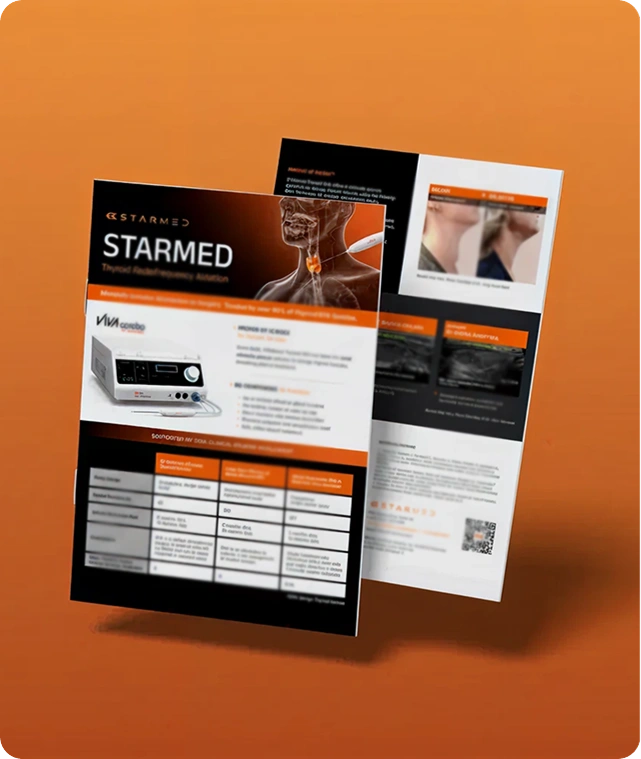
TL;DR: This clinician-focused overview explains how thyroid radiofrequency ablation (RFA) is used to treat benign thyroid nodules through a minimally invasive, ultrasound-guided approach. It outlines how the procedure works, what conditions it treats, and why RFA is increasingly adopted as a non-surgical alternative to thyroidectomy.
- Thyroid RFA uses targeted thermal energy to induce coagulative necrosis, resulting in progressive and durable thyroid nodule volume reduction while preserving thyroid function.
- The procedure is performed outpatient under local anesthesia using continuous ultrasound guidance and typically takes 20 to 45 minutes.
- Clinical evidence supports RFA for symptomatic benign thyroid nodules and autonomously functioning nodules, with low complication rates and rapid recovery.
- Most patients resume normal activities within 24 hours, with only mild, short-term post-procedural discomfort.
- Thyroid RFA is reported using dedicated CPT Category I codes, with insurance coverage increasingly available and overall costs generally lower than surgical alternatives.
Radiofrequency ablation (RFA) is a minimally invasive, image-guided technique increasingly used to treat benign thyroid nodules while preserving thyroid function. In a thyroid-focused radiofrequency ablation procedure, targeted thermal energy is delivered through a thin electrode. The goal is to induce coagulative necrosis within the nodule, leading to progressive volume reduction over time.
For clinicians searching for non-surgical alternatives to thyroidectomy that can be performed in-office, understanding what an RFA procedure is and how it is performed is essential. Continue reading to learn the basics of RFA.
What Conditions Are Treated with Thyroid RFA?
Thyroid RFA is a minimally invasive procedure for patients with symptomatic thyroid nodules causing compressive symptoms, cosmetic concerns, or local discomfort. Multiple studies demonstrate that RFA achieves significant nodule volume reduction while maintaining normal thyroid function and avoiding surgical risks. RFA has also shown favorable outcomes for autonomously functioning thyroid nodules in appropriately selected patients.
RFA can also be used in pain management and musculoskeletal applications.
How Is a Thyroid Radiofrequency Ablation Procedure Performed?
A thyroid radiofrequency ablation procedure is performed in an outpatient setting under local anesthesia. How long an RFA procedure takes depends on the complexity of the procedure. On average, it takes between 20 and 45 minutes.
During the RFA procedure, the clinician inserts a specialized RF electrode into the thyroid nodule using continuous ultrasound guidance. Once positioned, radiofrequency energy is applied to generate localized heat, inducing controlled tissue necrosis.
Over subsequent weeks and months, the ablated tissue is gradually resorbed. This results in durable nodule shrinkage.
Recovery and Post-Procedure Expectations
After the RFA procedure, patients are typically observed briefly and discharged the same day. Mild neck discomfort or swelling may occur but usually resolves within several days. Most patients resume normal activity within 24 hours.
Cost Considerations
How much an RFA procedure costs varies by region and care setting. In the United States, thyroid radiofrequency ablation is reported using dedicated CPT Category I codes, 60660 and 60661. These were recently introduced to better reflect percutaneous ablation of thyroid tissue. While coverage policies continue to evolve, reimbursement is increasingly available
Thyroid RFA is generally more cost-effective than surgery due to its outpatient nature, lack of general anesthesia, and minimal recovery time.
Is the RFA Procedure Right for Your Practice?
If you’re considering offering radiofrequency ablation in your practice, speaking with a STARMED America representative can provide clarity and personalized guidance. Our team is ready to answer your questions, explain your options, and help you determine the best next step in your clinical practice. Reach out today to discuss your situation and learn whether RFA is the right treatment modality for your patients.